I have been thinking about chocolate differently for about fifteen years.
Not obsessively. Not forensically. But in the way you think about something when someone shows you a piece of information that you cannot un-see.
Here is the thing about the food industry right now. It is in a strange place. Everything is becoming functional. Protein in your cereal. Vitamins in your water. Adaptogens in your snack bar. The race to make food do something beyond feed you is accelerating and I understand why. People care more about what they eat and that is genuinely good.
But most functional food tastes like a compromise. You can feel it. Something is slightly off. The texture, the aftertaste, the sweetness that almost gets there but doesn’t quite land. And that compromise comes from an assumption so deeply embedded in the industry that almost nobody questions it.
The assumption is that to make food better you have to remove something. Less sugar. Less fat. Less of whatever the problem is this decade.
But what if the problem was never the amount? What if it was the type?
What I Learned About Sugar That Changed How I Saw Everything
Here is what most people don’t know about sugar. Not all sugars are the same thing.
Not even close.
When you eat conventional sugar, sucrose, it breaks down fast. It enters your bloodstream quickly. Your body has to respond quickly. That response is what creates the spike, the brief high, and then the dip, the heaviness, the craving an hour later. Most people recognise the feeling without ever connecting it specifically to the type of sugar they ate. They just know that after certain things they feel a certain way.
Now here is where it gets interesting.
In 1995 a German molecular biologist named Dr Johannes Coy was researching how cancer cells fuel themselves. What he discovered, almost as a byproduct of that research, was a gene called TKTL1. Think of it as a kind of traffic controller inside your cells. It governs, in part, how sugar gets processed at a molecular level. And what he found was that different sugars take completely different routes through that system.
Some sugars rush through. Some go slowly. Some barely register at all in terms of blood glucose response.
The glycaemic index of conventional sugar is 65. One of the sugars Dr Coy identified, Tagatose, which occurs naturally in small amounts in dairy and certain fruits, has a glycaemic index of 3. Another, Galactose, found naturally in milk, sits at 20. These are not marginal differences. These are different experiences entirely at a cellular level, from what your taste buds experience as the same sweetness.
That discovery sat in academic papers for years. Dr Coy spent decades turning it into something practical. I met him ten years ago and spent the years since working on exactly one question: what happens when you bring this science to real food.
Which Brings Me To The Chocolate
Chocolate is the most emotionally loaded food there is. I love chocolate, you probably do too, but whenever I eat it I’m always conscious of the fact that it’s not good for me. Everyone has a relationship with it. Almost everyone feels something complicated about it. The pleasure is real. The guilt is real. The compromise between the two has been accepted as inevitable for so long that most people don’t even think to question it.
But we did question it.
If the problem is the sugar, and we now understand which sugars behave differently and why, then the question becomes simple. What happens if you build chocolate with those sugars instead?
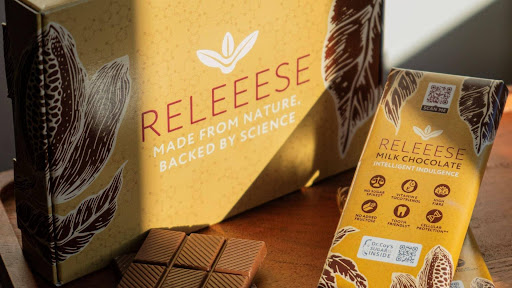
That is why we created RELEEESE Milk Chocolate. The world’s first milk chocolate combining Tagatose and Galactose. Same taste. Same texture. Same pleasure. A completely different response inside your body.
With authorised EU and UK health claims confirming a lower blood glucose rise, it’s also high in fibre and contains Vitamin E as Tocotrienols, which your cells use as protection against oxidative stress. It’s a chocolate bar with no artificial sweeteners, no added fructose and no compromise. Just a patented formulation built on thirty years of science.
It tastes like chocolate because it is chocolate. It just doesn’t do what conventional chocolate does to your body.
We call that Intelligent Indulgence.
So How Far Does This Go?
The real question at the heart of the functional food trend is, ‘how far can it go before it stops being food and starts being something else entirely?’
I think the answer depends on which direction you are coming from. If you start from function and try to add taste, you get most of what is currently on the shelf. Products that work in theory and compromise in practice.
But if you start with taste, respect the culinary heritage of the food, and use molecular science to rethink the underlying components, something entirely new emerges. You get food that performs beautifully because it is architected differently from the very first step. Dr Coy spent decades finding that answer. We spent ten years bringing it to food. The result doesn’t taste like a compromise.
With RELEEESE Milk Chocolate currently on sale and a dark chocolate coming to the market soon, we’re on a mission to make chocolate a guilt-free intelligent indulgence. You’ll never need to feel bad about eating chocolate again.
The problem was never chocolate. The problem was that for decades nobody looked seriously at the sugar inside it.
We looked. This is what we found.
Author Bio
Ali Ghaidan is CEO of RELEEESE and co-founder of Intelligent Sugar GmbH alongside Dr Johannes Coy. Made By Nature, Backed By Science. releeese.com.